Walk into any major supermarket in Dhaka today and look at the labels on juices, confectionery, or dairy products. More and more, you will see a phrase that is quietly transforming the food industry: "colors from natural sources."
Natural Food Colors Supplier in Bangladesh this is not a marketing trend, It is a deep structural shift happening across global food manufacturing — and Bangladesh's food and beverage industry is right in the middle of it. Manufacturers from Dhaka to Chittagong are under increasing pressure from consumers, export partners, and regulatory bodies to replace petroleum-derived synthetic food dyes with natural colorants sourced from plants, fruits, algae, and spices.

In this guide, we break down everything Bangladesh's food manufacturers need to know about natural food colors — the market data, the types and applications, the regulatory landscape, the challenges, and critically, how to source quality natural colorants right here in Bangladesh.
The Global Natural Food Colors Market: Numbers Every Bangladeshi Manufacturer Should Know
The scale of the global shift toward natural food colors is striking. The global natural food colors market was valued at USD 2.1–2.3 billion in 2024 and is projected to nearly double — reaching USD 4.0–4.7 billion by 2033–2035, growing at a compound annual growth rate (CAGR) of approximately 7–8.5% per year.
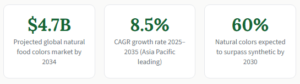
Asia Pacific is the fastest-growing region, with a projected CAGR of 8.6% from 2025 to 2033. For Bangladesh's food manufacturers, this matters: the buyers you are trying to reach —
export partners in the EU, USA, and Southeast Asia — are aggressively demanding natural colorants. Manufacturers that do not make the switch risk being locked out of premium export markets.
"Shoppers are actively avoiding 'artificial' labels, while authorities are tightening oversight on synthetic dyes. This is creating a structural shift toward natural, traceable, and functional color solutions."
— Vidyesh Swar, Principal Consultant, Towards FnB (2025)
Within Bangladesh itself, the packaged food market is growing rapidly, driven by urbanization, rising incomes, and a younger, more health-conscious population. The Bangladesh foodservice market is estimated at USD 4.32 billion in 2025 and is projected to reach USD 8.05 billion by 2030 — growing at a CAGR of 13.25%. This explosive growth means more food products on shelves, more competition for consumer attention, and more reason to invest in visually appealing, naturally colored products.
Why Are Bangladesh Manufacturers Making the Switch?
There are five converging forces pushing Bangladesh's food and beverage manufacturers toward natural colors:
1. Consumer Health Consciousness is Rising Fast
Bangladesh's growing urban middle class is increasingly reading food labels and making choices based on ingredient transparency. There has been a surge in demand for healthy and organic food options in Bangladesh, as consumers become more health-conscious and prioritize sustainability in their food choices. Synthetic dyes — particularly Red 40, Yellow 5, and Blue 1 — are increasingly associated in public perception with allergic reactions, hyperactivity in children, and long-term health concerns.
2. Export Markets Demand It
If you are manufacturing food products for export to Europe, the United States, or the Gulf markets, natural colors are increasingly non-negotiable. The European Union has strict regulations on synthetic dyes, requiring warning labels on products containing certain artificial colors. This alone makes natural colors a business necessity for any Bangladeshi exporter targeting these markets.
3. The Clean-Label Movement
"Clean label" — products made with simple, recognizable ingredients — is the dominant trend reshaping global food manufacturing. Key trends in Bangladesh's packaged food market focus on nutritional ingredients and sustainable packaging, aligning with global standards. Natural colors are a cornerstone of clean-label formulation. Brands that can display "colored with turmeric" or "colored with beta-carotene" on their packaging build stronger consumer trust.
4. Regulatory Pressure is Increasing Globally
In May 2025, the U.S. FDA approved three new natural color additives — Galdieria extract blue, butterfly pea flower extract, and calcium phosphate — marking a clear regulatory direction away from synthetic dyes. Bangladesh's food safety regulations are also evolving, and early adoption of natural colorants positions manufacturers ahead of future mandatory requirements.
5. Competitive Differentiation
In a crowded Bangladesh food market, natural colors offer a powerful point of differentiation. A beverage with "no artificial colors" on the label commands a premium price point and attracts health-oriented consumers — a segment that is growing faster than any other in Bangladesh's food sector.

Types of Natural Food Colors: A Complete Reference Guide
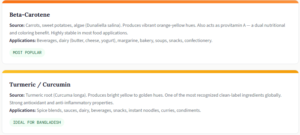
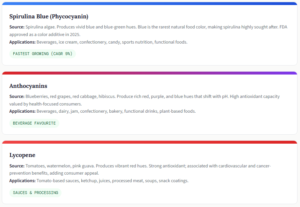
Natural food colors are derived from plant, animal, and mineral sources. Here is a comprehensive reference for Bangladesh's food manufacturers, covering the most important natural colorants, their sources, the colors they produce, and their primary food applications.
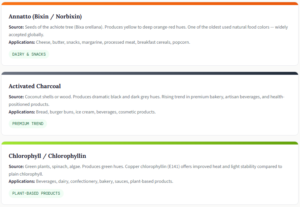
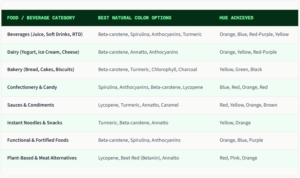
Natural Food Color Applications: A Quick Reference for Manufacturers
The table below maps the most common natural food colors to their primary applications in Bangladesh's food & beverage industry:
Challenges of Using Natural Food Colors — And How to Overcome Them
Natural colors are not a drop-in replacement for synthetic dyes. Bangladesh's food manufacturers need to understand the technical challenges and plan accordingly:
- Stability: Natural colors can degrade when exposed to heat, light, and pH changes. For example, anthocyanins are highly pH-sensitive — they appear red in acidic conditions and blue-purple in neutral conditions. Solution: Work with your ingredient supplier to select stabilized formulations and encapsulated colorants.
- Intensity: Natural colors are generally less intense than synthetic dyes, meaning you may need higher usage levels. This affects cost calculations. Solution: Use standardized, high-concentration extracts available from quality suppliers.
- Cost: Natural colors are typically more expensive than synthetic alternatives. However, the cost gap is closing as production scales up globally. Solution: Calculate the full value — including the premium pricing your products can command with clean-label positioning.
- Flavor Impact: Some natural colors can introduce slight flavors (e.g., turmeric has a mild earthy taste). Solution: Use deodorized or water-soluble versions with minimal flavor impact for sensitive applications like beverages.
- Regulatory Documentation: Using natural colors requires proper documentation — specification sheets, certificates of analysis (CoA), Halal certificates, and allergen information. Solution: Source from suppliers like ZHM Group that provide complete documentation with every product.
The Bangladesh Opportunity: Why Natural Colors Make Business Sense Right Now
Several Bangladesh-specific factors make 2026 the right time to make the natural color transition:
- Bangladesh's food export industry is growing rapidly. Frozen foods, processed seafood, and packaged products are reaching EU, USA, Middle East, and Southeast Asian markets — all of which have strict synthetic additive regulations.
- The domestic market is modernizing fast. Bangladesh's population is growing and urbanizing rapidly, leading to busier lifestyles and a growing demand for convenient, ready-to-eat processed foods. These consumers are reading labels.
- Plant protein is surging. The plant protein market in Bangladesh is expected to grow by 29.6% on annual basis to reach USD 111.0 million in 2025. Plant-based products almost universally require natural coloring to maintain their clean-label credentials.
- Competition is intensifying. As more brands enter Bangladesh's packaged food market, natural colors offer a genuine differentiation point — especially in beverages, dairy, and confectionery.
- Beta-carotene has a dual nutritional function. In a country with documented Vitamin A deficiency, products colored with beta-carotene deliver a genuine nutritional benefit — the same logic behind ZHM Group's FFI Smart Sugar, fortified with Vitamin A.
"By 2030, natural food colors are expected to surpass synthetic colors, capturing nearly 60% of the global market share. Bangladesh manufacturers who make the switch now will be positioned ahead of this curve."
— Future Market Insights, Natural Food Colors Market Report 2025
How to Source Natural Food Colors in Bangladesh: What to Look For
Not all natural color suppliers are equal. When selecting a natural food color supplier for your Bangladesh manufacturing operation, evaluate them on these critical criteria:
- Quality Certification: Ensure the supplier provides internationally recognized Certificates of Analysis (CoA) with every batch. The colorant should meet BP, USP, or EU food additive standards.
- Halal Certification: For Bangladesh's food manufacturers supplying domestic and Middle Eastern markets, Halal certification is non-negotiable. Confirm that your natural colors — particularly carmine and shellac — meet Halal requirements.
- Technical Support: Natural colors behave differently in different food matrices. Your supplier should be able to advise on formulation, concentration levels, and stability across your specific product applications.
- Documentation: Complete documentation — CoA, MSDS, technical data sheets, allergen statements, and country of origin — is essential for your product registration and export compliance.
- Consistent Stock Availability: Natural color supply can be seasonally affected. Choose a supplier with stable inventory and transparent lead times.
- Competitive Pricing with Volume Flexibility: Whether you need small trial quantities or large production volumes, your supplier should accommodate both with transparent pricing.
ZHM Group: Your Natural Food Color Supplier in Bangladesh
ZHM Group has been supplying premium-quality food ingredients to Bangladesh's food and beverage manufacturers for over 20 years. Our natural food color portfolio includes the most in-demand plant-derived colorants — available in food-grade quality with full documentation, ready for delivery to your facility across Bangladesh.
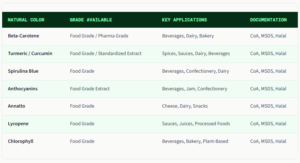
We supply natural colors sourced from certified global manufacturers — with full traceability, competitive pricing, and the technical support you need to successfully formulate with natural colorants. Samples are available on request.
Contact our ingredients team today: +88029634158, +8801726968877 | zhmltd.com/contact
FAQ: Natural Food Colors Supplier in Bangladesh
What are natural food colors and how are they different from synthetic dyes?
Natural food colors are pigments extracted from plant, animal, or mineral sources — such as beta-carotene from carrots, spirulina blue from algae, turmeric yellow from curcumin, and anthocyanins from berries. Synthetic food dyes are petroleum-derived chemical compounds like Red 40, Yellow 5, and Blue 1. Natural colors are preferred for clean-label formulations, export market compliance, and health-conscious consumer segments.
Are natural food colors safe and Halal-certified?
Yes — most natural food colors sourced from plant sources (beta-carotene, turmeric, spirulina, anthocyanins, annatto) are inherently Halal and do not require special certification. One exception is carmine (E120), derived from insects, which is not Halal. ZHM Group supplies only plant-sourced natural colors suitable for Halal food production, with certificates available on request.
Why are natural food colors more expensive than synthetic dyes?
Natural colors require agricultural cultivation, harvesting, and complex extraction processes — making them inherently more expensive than synthetic dyes manufactured in chemical plants. However, costs are falling as global production scales up. The additional cost is often offset by the premium pricing that clean-label, naturally colored products can command in the market.
Where can I source natural food colors in Bangladesh?
ZHM Group is one of Bangladesh's leading suppliers of natural food colors, including beta-carotene, turmeric/curcumin, spirulina blue, anthocyanins, annatto, and lycopene. We supply food-grade quality with full documentation including Certificates of Analysis (CoA), MSDS, and Halal certificates. Contact us at +880-2-9634158 or visit zhmltd.com/natural-colors-beta - carotene
What is the most popular natural food color for Bangladesh beverage manufacturers?
Beta-carotene is the most widely used natural food color in beverages globally, producing orange-yellow hues stable across most beverage applications. Spirulina blue is the fastest-growing due to unique blue hues. For Bangladesh's beverage manufacturers, turmeric (yellow), anthocyanins (red/purple from hibiscus — very popular in local beverages), and beta-carotene (orange) are the most relevant options.
The Time to Switch is Now
The shift from synthetic to natural food colors is not coming to Bangladesh — it is already here. Consumer preferences, export market requirements, and regulatory trends are all pointing in the same direction. Manufacturers who make this transition proactively will gain export market access, premium positioning, and a durable competitive advantage over those who wait.
The good news for Bangladesh's food manufacturers: you do not have to navigate this transition alone. ZHM Group has 20+ years of experience supplying certified food ingredients to manufacturers across Bangladesh — and our natural food color portfolio gives you everything you need to reformulate with confidence.