ভিটামিন A সমৃদ্ধ স্মার্ট সুগার! — এখন বাজারে
Walk into any major supermarket in Dhaka today and look at the labels on juices, confectionery, or dairy products. More and more, you will see a phrase that is quietly transforming the food industry: "colors from natural sources."
This is not a marketing trend. It is a deep structural shift happening across global food manufacturing — and Bangladesh's food and beverage industry is right in the middle of it. Manufacturers from Dhaka to Chittagong are under increasing pressure from consumers, export partners, and regulatory bodies to replace petroleum-derived synthetic food dyes with natural colorants sourced from plants, fruits, algae, and spices.

In this guide, we break down everything Bangladesh's food manufacturers need to know about natural food colors — the market data, the types and applications, the regulatory landscape, the challenges, and critically, how to source quality natural colorants right here in Bangladesh.
The scale of the global shift toward natural food colors is striking. The global natural food colors market was valued at USD 2.1–2.3 billion in 2024 and is projected to nearly double — reaching USD 4.0–4.7 billion by 2033–2035, growing at a compound annual growth rate (CAGR) of approximately 7–8.5% per year.
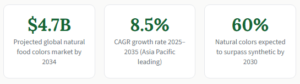
Asia Pacific is the fastest-growing region, with a projected CAGR of 8.6% from 2025 to 2033. For Bangladesh's food manufacturers, this matters: the buyers you are trying to reach —
export partners in the EU, USA, and Southeast Asia — are aggressively demanding natural colorants. Manufacturers that do not make the switch risk being locked out of premium export markets.
"Shoppers are actively avoiding 'artificial' labels, while authorities are tightening oversight on synthetic dyes. This is creating a structural shift toward natural, traceable, and functional color solutions."
There are five converging forces pushing Bangladesh's food and beverage manufacturers toward natural colors:
Bangladesh's growing urban middle class is increasingly reading food labels and making choices based on ingredient transparency. There has been a surge in demand for healthy and organic food options in Bangladesh, as consumers become more health-conscious and prioritize sustainability in their food choices. Synthetic dyes — particularly Red 40, Yellow 5, and Blue 1 — are increasingly associated in public perception with allergic reactions, hyperactivity in children, and long-term health concerns.
If you are manufacturing food products for export to Europe, the United States, or the Gulf markets, natural colors are increasingly non-negotiable. The European Union has strict regulations on synthetic dyes, requiring warning labels on products containing certain artificial colors. This alone makes natural colors a business necessity for any Bangladeshi exporter targeting these markets.
"Clean label" — products made with simple, recognizable ingredients — is the dominant trend reshaping global food manufacturing. Key trends in Bangladesh's packaged food market focus on nutritional ingredients and sustainable packaging, aligning with global standards. Natural colors are a cornerstone of clean-label formulation. Brands that can display "colored with turmeric" or "colored with beta-carotene" on their packaging build stronger consumer trust.
In May 2025, the U.S. FDA approved three new natural color additives — Galdieria extract blue, butterfly pea flower extract, and calcium phosphate — marking a clear regulatory direction away from synthetic dyes. Bangladesh's food safety regulations are also evolving, and early adoption of natural colorants positions manufacturers ahead of future mandatory requirements.
In a crowded Bangladesh food market, natural colors offer a powerful point of differentiation. A beverage with "no artificial colors" on the label commands a premium price point and attracts health-oriented consumers — a segment that is growing faster than any other in Bangladesh's food sector.

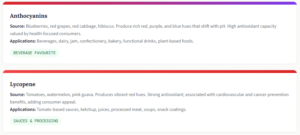
Natural food colors are derived from plant, animal, and mineral sources. Here is a comprehensive reference for Bangladesh's food manufacturers, covering the most important natural colorants, their sources, the colors they produce, and their primary food applications.