ভিটামিন A সমৃদ্ধ স্মার্ট সুগার! — এখন বাজারে
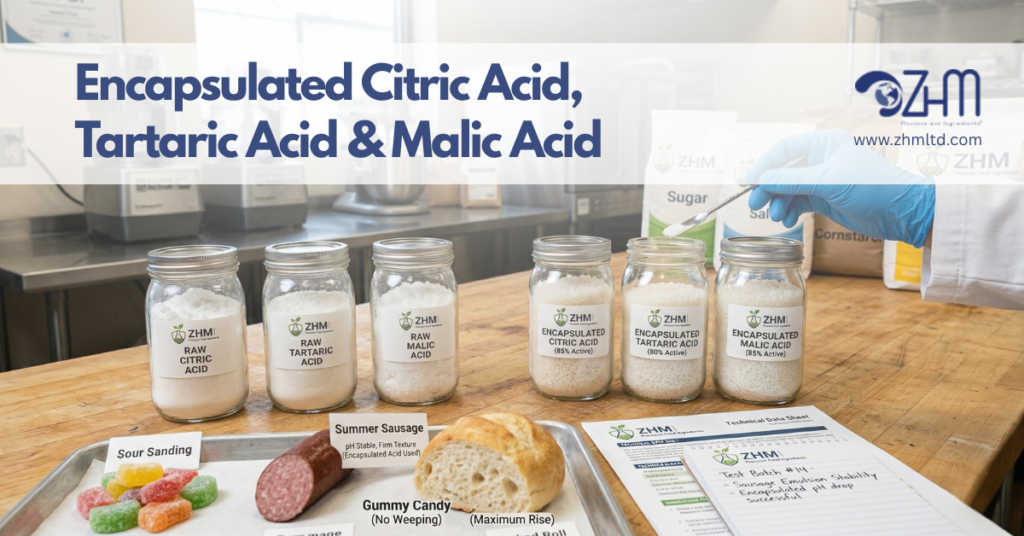
Acids are among the most versatile functional ingredients in food manufacturing. They modulate flavour, control pH, act as leavening agents, extend shelf life, inhibit microbial growth, and interact with proteins and starches in ways that shape texture and structure. Encapsulated Citric acid, tartaric acid, & malic acid are three of the most widely used organic acids across global food ingredients categories.
Yet in their raw, uncoated powder form, these acids present a challenge: they are highly reactive. The moment they encounter moisture — whether in a dough, a batter, a powder blend, or even ambient humidity on a factory floor — they begin to dissolve and react. This can trigger premature leavening, cause clumping in dry mixes, destabilise emulsions, or deliver sour flavour notes too early in the eating experience.
In the complex and ever-evolving world of food science and commercial food manufacturing, controlling chemical reactions is the key to creating stable, flavorful, and visually appealing products. Among the most critical tools in a food formulator’s arsenal are acidulants—specifically citric acid, tartaric acid, and malic acid. However, in their raw, bare forms, these acids can be highly reactive, hygroscopic, and destructive to product stability. They can prematurely break down starches, invert sugars, degrade proteins, and cause unwanted color changes.
Encapsulation is the solution.This is where the transformative technology of encapsulation comes into play. By coating these raw acids in protective barriers, manufacturers can precisely control when and where the acid is released. Whether triggered by heat, moisture, or mechanical action, encapsulated acids offer unprecedented control over the manufacturing process.
If you are navigating the vast landscape of food ingredients, understanding the nuances of Encapsulated Citric Acid, Tartaric Acid & Malic Acid is absolutely essential for modern product development. In this comprehensive guide, we will explore exactly what these ingredients are, the exhaustive variants available, their critical applications in food, how to choose the right one for your formulation, and why ZHM should be your trusted manufacturing partner.
To understand encapsulated acids, we must first understand the process of microencapsulation. In food manufacturing, encapsulation is a specialized technological process where tiny particles or droplets of an active ingredient (in this case, the acidulant) are surrounded by a coating, or shell, to create small capsules.
Raw acids are highly reactive. If you add raw citric acid to a gummy candy formulation too early, it will cause "sugar inversion"—breaking down sucrose into glucose and fructose, resulting in a sticky, "weeping" candy that melts at room temperature. If you add raw acid to raw meat for sausage making, it will prematurely denature the proteins, resulting in a crumbly, unpalatable texture.
Encapsulation acts as a physical barrier that prevents the acid from interacting with the surrounding ingredients—such as water, proteins, leavening agents, or sugars—until a specific parameter is met. Most commonly, this trigger is thermal (heat). For example, an encapsulated acid might be designed with a lipid coating that only melts at 140°F (60°C). During mixing and resting at room temperature, the acid remains trapped and inert. Only when the product enters the oven or the smokehouse does the lipid melt, releasing the acid to perform its function at the exact right moment.
The most common method for creating these ingredients is Fluidized Bed Coating. In this advanced process, the raw acid crystals are suspended in a chamber by a high-velocity stream of air. While suspended, a liquid coating material (the melted fat or wax) is sprayed onto the particles. As the particles circulate in the cool air, the coating solidifies, creating a perfectly uniform, microscopic shell around each individual acid crystal. This ensures a consistent release profile and prevents "leakage" of the acid during storage and early-stage processing.
Not all encapsulated acids are created equal. Formulators require different active levels, different release temperatures, and different base acids depending on the desired flavor profile and chemical reaction. Below is a comprehensive breakdown of the types and variants available on the market.
Citric acid is the most widely used acidulant in the food industry, known for its sharp, clean, and refreshing tartness that hits the palate immediately and dissipates relatively quickly.
| Variant | Coating Material | Release Trigger | Typical Load(%) | Primary Applications |
|---|---|---|---|---|
| ECA-50 HVO | Hydrogenated vegetable oil | Heat (60–75°C) |
50% |
Baked goods, bread improvers |
| ECA-70 HVO | Hydrogenated vegetable oil | Heat (60–75°C) |
70% |
Cheese processing, meat products |
| ECA-50 HPO | Hydrogenated palm oil | Heat (55–70°C) |
50% |
Crackers, savoury snacks |
| ECA-MD | Maltodextrin | Moisture/water |
50% |
Dry beverage mixes, effervescent tablets |
| ECA-70 Wax | Carnauba / beeswax blend | Heat + shear |
70% |
Hard confectionery, gummies |
Malic acid, naturally found in apples, provides a smooth, lingering, and intensely fruity tartness. It is the secret behind "extreme sour" candies, as its flavor profile lasts longer on the palate than citric acid.
| Variant | Coating Material | Release Trigger | Typical Load(%) | Primary Applications |
| EMA-50 HVO | Hydrogenated vegetable oil | Heat (60–75°C) |
50% |
Sour confectionery, chewing gum |
| EMA-70 HVO | Hydrogenated vegetable oil | Heat (65–80°C) |
70% |
Hard candy centres, fruit snacks |
| EMA-50 MCT | MCT oil | Heat (45–60°C) |
50% |
Sports nutrition, health bars |
| EMA-MD | Maltodextrin | Moisture/water |
50% |
Dry fruit drink mixes, instant soups |
| EMA-50 Wax | Carnauba wax | Shear + heat |
50% |
Compressed tablets, powder-coated snacks |
Tartaric acid is highly specialized. Found naturally in grapes and tamarind, it has a very hard, highly astringent, and dry sourness. It is incredibly reactive and requires precise handling.
| Variant | Coating Material | Release Trigger | Typical Load (%) | Primary Applications |
| ETA-50 HVO | Hydrogenated vegetable oil | Heat (60–75°C) |
50% |
Baking powder blends, cake mixes |
| ETA-60 HVO | Hydrogenated vegetable oil | Heat (65–80°C) |
60% |
High-temperature baking, pizza dough |
| ETA-50 HPO | Hydrogenated palm oil | Heat (55–70°C) |
50% |
Gluten-free baking, flatbreads |
| ETA-MD | Maltodextrin | Moisture/water |
50% |
Jelly powders, flavoured water mixes |
Technical Note: "Acid load" refers to the percentage of active acid in the encapsulated particle. A 70% load product contains 70 g of active acid per 100 g of encapsulated ingredient — offering greater potency per unit weight, but potentially a thinner, more fragile coating. Always evaluate both the active load and the coating integrity (assessed via dissolution/release profiling) for your specific process conditions.
The introduction of encapsulated technology has revolutionized several sectors of food manufacturing. By preventing premature reactions, manufacturers can streamline production, increase shelf life, and dramatically improve product quality.
Alt text: Gummy candies, summer sausages, and baked goods which rely on encapsulated citric, malic, and tartaric acid for stability and flavor.
Perhaps the most crucial application of encapsulated acids is in the confectionery industry, specifically in sour gummies and hard candies. When you coat a gummy worm in a sour sugar mixture, the acid is exposed to the moisture of the gummy and the ambient humidity in the air. Raw citric or malic acid is highly hygroscopic; it will pull water from the air, causing the candy to "sweat" or "weep." Furthermore, the acid will cause sugar inversion, turning the firm gummy into a sticky, unappealing mess.
By using Encapsulated Malic Acid or Encapsulated Citric Acid in the sanding sugar, the acid is protected by a micro-thin layer of fat. This barrier prevents the acid from reacting with the sugar or drawing in moisture. When the consumer eats the candy, the mechanical action of chewing and the warmth of the mouth breaks the capsule, releasing the intense sour flavor instantly. For more on stabilizing gummy candies, explore our guide on confectionery stabilizers.
In the production of semi-dry and dry sausages like summer sausage, pepperoni, and salami, lowering the pH is critical for food safety, texture, and flavor. Traditionally, this is done using lactic acid starter cultures that slowly ferment the meat over days.
To speed up production, manufacturers can use a direct acidulant (like citric acid) to immediately drop the pH. However, adding raw acid to raw meat instantly denatures the meat proteins, breaking the emulsion and resulting in a crumbly, dry sausage.
The solution is Encapsulated Citric Acid. The encapsulated acid is mixed into the cold meat batter. The lipid coating protects the meat proteins from the acid during stuffing and resting. Once the sausages are moved to the smokehouse and the internal temperature reaches the melting point of the coating (usually around 135°F - 140°F), the fat melts, releasing the citric acid to drop the pH perfectly, ensuring a firm sliceability, a tangy flavor, and robust food safety. Learn more about meat processing chemistry in our meat preservatives section.
In baking, acids are used to react with bases (like baking soda) to create carbon dioxide, which leavens the dough or batter. If raw acid is used, it will react with the baking soda as soon as water is added to the bowl. This premature gas release means less rise in the oven, resulting in dense cakes or flat breads.
Encapsulated Tartaric Acid and Encapsulated Citric Acid act as highly controlled chemical leavening agents. The acid is protected during the mixing and proofing stages. Only when the dough enters the hot oven does the coating melt, releasing the acid to react with the baking soda, providing maximum "oven spring" and a perfectly aerated crumb structure. This is especially vital in the production of commercial tortillas, ensuring they remain fluffy and pliable.
Think of a sharply tart salt-and-vinegar chip or a spicy-sour tortilla chip. Applying raw acid to snack seasonings often results in clumping inside the packaging machinery due to the acid absorbing ambient humidity. Furthermore, raw acid can react with other spices in the blend, degrading their color and flavor over time. Encapsulation prevents hygroscopic clumping, ensures free-flowing seasoning blends, and provides a targeted burst of flavor when the snack is consumed.
For powdered sports drinks, lemonades, and nutritional supplements, stability on the shelf is paramount. If raw acids are mixed with sugar and stored in a humid environment, the entire mix can turn into a solid brick. Encapsulated acids (often utilizing water-soluble or highly resilient lipid coatings) protect the integrity of the dry mix, ensuring a free-flowing powder that instantly dissolves and provides the correct flavor profile upon hydration.
Selecting the correct encapsulated acid is a highly technical decision that dictates the success or failure of your formulation. Formulators must evaluate several parameters to make the right choice:
You must understand your manufacturing process to choose the right coating.
Important Note: In complex processes involving both heat and moisture — such as steam injection baking or extrusion cooking — conduct release profiling under your actual process conditions. Coating behaviour can be influenced by both temperature and water activity simultaneously.
Higher acid-load variants (e.g., 70%) offer cost-efficiency per unit of active acid but may have thinner coatings that are more susceptible to mechanical damage during blending, pneumatic conveying, or transport. For fragile process steps, a 50% load with a thicker, more robust coating may actually perform better and deliver more consistent results despite the lower active content per gram.
All three acids — and their standard encapsulation materials — are approved under EU food law (E330, E334, E296), US FDA GRAS classifications, and Codex Alimentarius. However, if your product targets a specific market or claim (organic, vegan, halal, kosher, non-GMO), the encapsulation coating material must be assessed accordingly. Palm-based coatings, for example, may require RSPO certification for sustainability-committed brands. Always request a full technical data sheet and certificate of analysis from your supplier.
Particle size affects both the rate of release and the homogeneity of distribution in your product. Fine granules (80–150 µm) blend more uniformly in fine powders but may be more fragile. Coarser grades (300–500 µm) are more robust in handling but can lead to uneven distribution in fine blends. Ask your supplier for the particle size distribution (PSD) data and compare it against your other dry blend components.
When you are formulating products on a commercial scale, the quality of your raw materials directly impacts your bottom line. A failed encapsulation—where the acid leaks prematurely—means ruined batches, wasted labor, and potentially catastrophic product recalls. This is why leading food manufacturers globally trust ZHM for their encapsulated ingredient needs.
Alt text: ZHM laboratory testing the release point and coating integrity of encapsulated food acids.
At ZHM, our state-of-the-art fluidized bed microencapsulation technology ensures an incredibly uniform coating. We eliminate the microscopic fissures and uneven thicknesses that plague lower-quality competitors. This guarantees zero premature acid leakage, ensuring your gummies never weep and your sausages never crumble.
We understand that one size does not fit all. ZHM offers customized lipid coatings tailored exactly to your manufacturing process. Whether you need an ultra-low melt point for a delicate meat emulsion or a high-shear resistant coating for industrial baking, our R&D team can engineer the exact release profile your facility requires.
Food safety and consistency are our top priorities. All ZHM encapsulated acids—whether Citric, Malic, or Tartaric—are produced in strictly controlled, GFSI-certified facilities. Every batch undergoes rigorous testing for active percentage, melt-point accuracy, and particle size distribution.
In a volatile global market, ingredient shortages can halt your production lines. ZHM maintains robust, redundant supply chains and strategic warehousing, ensuring that you receive your encapsulated ingredients on time, every time, regardless of global logistics disruptions.
When stored correctly in a cool, dry environment away from direct sunlight and extreme heat (which could prematurely melt the lipid coating), encapsulated acids typically boast a shelf life of 18 to 24 months. Proper storage is crucial to maintaining the integrity of the micro-shell.
Regular citric acid reacts immediately upon contact with moisture — which can trigger early leavening or sourness before baking or processing is complete. Encapsulated citric acid is coated with a protective shell (typically hydrogenated vegetable oil or maltodextrin) that delays release until a specific temperature or mechanical shear is reached. This controlled-release behaviour improves product shelf life, process stability, and flavour consistency — particularly in dry mixes, baked goods, and thermally processed foods.
Generally, yes. The core acids (citric, malic, tartaric) are derived from plant sources or fermentation. The lipid coatings used by premium manufacturers like ZHM are typically plant-based (hydrogenated vegetable oils like palm or soy). Always request the technical data sheet and certification documents from your supplier to ensure they meet your specific dietary labeling requirements.
Yes. Encapsulated tartaric acid is widely used in gluten-free baking formulations. It acts as a reliable leavening acid that activates at the correct oven temperature, helping gluten-free doughs achieve proper rise and texture without the structural support of gluten. It also imparts a clean, mild tartness that complements grain-free and alternative flour products. Fat-coated grades with a release trigger of 60–75°C are typically recommended for conventional oven temperatures.
Lipid-coated encapsulated acids are generally not recommended for ready-to-drink (RTD) liquid beverages. Because the coating is fat-based, it will not dissolve in cold water and can leave an unappealing waxy film or floating particles in the drink. Encapsulated acids are designed for dry mixes, baking, meats, and confections.
Yes. Citric acid (E330), tartaric acid (E334), and malic acid (E296) are all approved by the European Food Safety Authority (EFSA), carry US FDA GRAS status, and are listed in Codex Alimentarius. The encapsulation coatings — food-grade hydrogenated vegetable fats, waxes, or hydrocolloids — are equally approved for food applications. All ZHM-supplied encapsulated acid products come with full regulatory documentation including Certificates of Analysis, safety data sheets, and allergen declarations.
"Weeping" or "sweating" in gummy candies is primarily caused by sugar inversion. Raw acids pull moisture from the air and break down sucrose into sticky fructose and glucose. By switching to an encapsulated acid for your sanding sugar, the acid is physically blocked from interacting with the sugar and moisture, keeping the candy dry and shelf-stable.
Encapsulated acids should be stored in cool, dry conditions — ideally below 25°C — away from direct sunlight and humidity. Fat-based encapsulation coatings can soften or melt at elevated temperatures, which would cause premature release of the active acid core and potential clumping. Always store in sealed, moisture-proof packaging and observe the manufacturer's recommended shelf life, typically 12–24 months from production. Once packaging is opened, reseal immediately and use within the recommended period. ZHM packaging is designed for ambient warehouse conditions with moisture-barrier inner liners.
Citric acid provides a sharp, rapid burst of tartness that cleanses the palate quickly—think of the bite of a fresh lemon. Malic acid, naturally found in green apples, provides a smoother, intensely fruity, and highly persistent sourness that lingers on the tongue. Many formulators use a blend of both to create a multidimensional sour experience.
Ready to elevate your product formulation, stabilize your shelf life, and optimize your food manufacturing process? Stop letting raw acids dictate your production schedule.
Partner with the industry leaders in precision ingredient technology. Contact ZHM today to speak with our food science experts, request technical data sheets, and order custom samples of our premium Encapsulated Citric, Malic, and Tartaric Acids. Let us help you build a better, more stable product.