ভিটামিন A সমৃদ্ধ স্মার্ট সুগার! — এখন বাজারে
Clean Label Anticaking Agents: Carrot Fibre & Bamboo Fibre — Complete Guide for Food Manufacturers
Bangladesh's food manufacturing sector is facing a dual challenge that is reshaping ingredient sourcing decisions across the industry. On one hand, the country's hot and humid tropical climate — with temperatures regularly exceeding 35°C and relative humidity above 75% — creates near-perfect conditions for powdered food ingredients to absorb atmospheric moisture, clump together, and lose their free-flowing properties. On the other hand, Bangladesh's increasingly informed consumer base is scrutinising ingredient labels more carefully than ever before, driving demand for clean-label products that contain recognisable, natural-origin ingredients rather than synthetic chemical additives.
Traditional anticaking agents — silicon dioxide (E551), magnesium stearate, sodium ferrocyanide (E535), and calcium silicate — are effective at preventing powder clumping. But they carry E-numbers, raise consumer concerns, and sit uncomfortably alongside "all-natural" or "clean-label" product positioning. For food manufacturers caught between the functional need for anticaking performance and the marketing imperative of clean-label formulation, the answer is increasingly clear: natural plant fibre anticaking agents.
ZHM Group, Bangladesh's trusted food and beverage ingredient supplier with over 20 years of sourcing experience, supplies two certified, clean-label anticaking agents — Carrot Fibre and Bamboo Fibre — to food manufacturers across Bangladesh. Both deliver reliable anticaking performance with a simple, consumer-friendly label declaration and no E-number required.
This comprehensive guide covers everything Bangladesh food manufacturers need to know about clean-label anticaking agents: how caking occurs, how plant fibres prevent it, a detailed comparison of Carrot Fibre and Bamboo Fibre, applications across major product categories, regulatory and labelling guidance, quality standards, and formulation recommendations.
To understand the value of clean label anticaking alternatives, we must first understand the fundamental problem they solve and how they operate within food systems.
Powdered food ingredients — spice blends, baking mixes, protein powders, seasoning mixes, dried milk, and powdered beverages — are inherently hygroscopic: they actively absorb moisture from the surrounding air. When moisture is absorbed onto the surface of powder particles, it acts as a binding agent, causing adjacent particles to stick together at their points of contact. Over time, as moisture absorption continues and cycles of ambient temperature and humidity fluctuate, these initial adhesions strengthen into hard, often irreversible clumps — a process known as caking.
Caking in food powders occurs through three primary mechanisms:
Anticaking agents are essential food additives or ingredients specifically designed to prevent the formation of lumps, ensuring that powdered or granulated food products remain free-flowing from production to the consumer's pantry. Anticaking agents interrupt the caking process through one or more of three mechanisms:
Moisture Absorption: Some anticaking agents (particularly fibrous materials like Carrot Fibre and Bamboo Fibre) have high water-binding capacity — they preferentially absorb moisture from the environment before it can reach the food powder particles, effectively acting as a moisture sink that protects the powder.
Particle Coating: Anticaking agents can coat individual powder particles, creating a physical barrier that prevents particle-to-particle contact and the formation of liquid bridges.
Physical Separation: By distributing themselves among food powder particles, anticaking agents physically separate particles, increasing the average inter-particle distance and reducing the probability of bridging and agglomeration.
For decades, the food industry relied heavily on traditional, synthetic anticaking agents. These include silicon dioxide (E551), calcium silicate (E552), and magnesium stearate (E470b). While undeniably effective and generally recognized as safe (GRAS), these ingredients sound chemical and artificial to the modern consumer.
The shift toward "clean label" products has created a significant demand for alternatives. Clean-label consumers want ingredient lists they can recognize, pronounce, and trust—ideally, ingredients derived from nature. Clean-label anticaking alternatives, such as natural plant fibres (like carrot and bamboo), offer a compelling solution. They provide the necessary functional performance—often acting through moisture absorption and physical separation—but allow manufacturers to declare a natural, recognizable ingredient on the label, eliminating the need for E-numbers or chemical-sounding names.
(Image placeholder: Infographic showing the mechanism of caking vs. how anticaking agents prevent it. Alt text: clean label anticaking supplier Bangladesh mechanism)
The most widely used traditional anticaking agents and their E-numbers include:
| Anticaking Agent | E-Number | Function | Clean-Label Issue |
| Silicon Dioxide | E551 | Moisture absorption, particle separation | Synthetic; nano-silica concerns |
| Magnesium Stearate | E572 | Particle coating, lubrication | Synthetic; associated with pharmaceutical tablets |
| Sodium Ferrocyanide | E535 | Crystal growth inhibitor | Contains cyanide (though safe) — consumer perception issue |
| Calcium Silicate | E552 | Moisture absorption | Synthetic mineral compound |
| Magnesium Carbonate | E504 | Moisture absorption | Synthetic |
| Potassium Ferrocyanide | E536 | Crystal growth inhibitor | Cyanide perception concern |
All of these require E-number declaration on the food label — a significant barrier for manufacturers targeting the growing clean-label premium segment. Consumer research consistently shows that shoppers respond negatively to E-numbers on labels, associating them with artificial, unhealthy, or industrially processed food.
Clean-label anticaking alternatives — ingredients that perform the same anticaking function but are declared by their natural, recognisable ingredient name rather than an E-number — solve this problem. ZHM Group supplies two of the most effective clean-label anticaking agents available: Carrot Fibre and Bamboo Fibre.
ZHM Group offers specialized, high-performance clean-label anticaking solutions tailored for various food manufacturing needs.
Sub-category: Clean Label Anticaking Agents:
Both of these clean-label solutions are available in various particle size grades (micronized options available) to perfectly match the specific density and requirements of your unique powder applications.
Carrot fibre is an innovative, highly functional ingredient that is gaining rapid traction in the food industry as a superior natural anticaking solution.
Carrot Fibre is a natural dietary fibre ingredient produced from the processing of carrots — typically as a value-added by-product of carrot juice production or carrot processing operations. The carrot pomace (the solid material remaining after juice extraction) is cleaned, processed, dried, and milled to produce a fine fibre powder that retains the fibre content, natural colouring compounds, and water-binding properties of the carrot plant.
Carrot fibre is primarily sourced as a valuable by-product of carrot juice extraction and processing. Rather than discarding the fibrous pulp, it is carefully collected, purified, and processed. The production typically involves drying—often spray-drying or gentle dehydration—followed by precise milling to achieve the optimal particle size for anticaking functionality. This upcycling process also makes it an environmentally sustainable choice.
Botanical origin: Daucus carota (Carrot) Production method: Carrot pomace washing → drying (spray-drying or drum-drying) → milling → sieving to particle size specification Primary active fraction: Insoluble dietary fibre (cellulose, hemicellulose, pectin) Colour: Natural orange, derived from residual carotenoids (beta-carotene) in the carrot cell walls Taste: Mild, slightly sweet — characteristic carrot note at high usage levels; virtually undetectable at anticaking usage levels (0.5–2%) Label declaration: "Carrot Fibre" — no E-number required; declared as a food ingredient
The primary mechanism of carrot fibre lies in its exceptional water-binding capacity (WBC). Carrot fibre has a highly porous, sponge-like cellular structure. When introduced into a powdered food matrix, it actively scavenges and absorbs ambient moisture from the environment or from the surrounding ingredients. By locking this moisture away within its fibrous matrix, it prevents the primary powder particles from becoming damp, sticky, and subsequently caking.
One of the defining characteristics of carrot fibre is its natural colour. Because it is minimally processed from real carrots, it retains a distinct, natural orange to yellow-orange hue.
Crucially, its label declaration is highly appealing: it is simply listed as 'Carrot Fibre'. This is the epitome of clean-label compliance, instantly recognizable and perceived positively by consumers. It requires no E-number and replaces synthetic additives.
The anticaking effectiveness of Carrot Fibre stems from its exceptionally high water-binding capacity (WBC) — the ability to absorb and retain many times its own weight in water. The insoluble fibre fraction (cellulose and hemicellulose) in Carrot Fibre has a large surface area with abundant hydroxyl (-OH) groups that form hydrogen bonds with water molecules.
When Carrot Fibre particles are blended into a food powder:
Beyond its functional role, carrot fibre offers a significant nutritional advantage. It is rich in both soluble and insoluble dietary fibres. Depending on the usage level in your formulation, incorporating carrot fibre as an anticaking agent can contribute to the overall dietary fibre content of your final product, potentially allowing for desirable nutritional claims (e.g., "Source of Fibre").
Unlike synthetic anticaking agents, which contribute nothing nutritionally to the product, Carrot Fibre provides a meaningful addition of dietary fibre to the formulated product. At typical anticaking usage levels of 0.5–2%, Carrot Fibre contributes:
This dual functionality — anticaking performance plus dietary fibre contribution — provides formulation efficiency that synthetic alternatives cannot match.
Carrot fibre is an exceptional choice for products where its natural orange colour is either advantageous or easily masked. Ideal applications include:
Best suited for:
Not recommended for:
Due to its inherent pigment, carrot fibre is not suitable for pure white or very light-coloured powders (e.g., icing sugar, white baking flour, clear beverage mixes) where an orange tinge would be visually unacceptable to the consumer.
Typical Usage Level: 0.5–2% of total powder weight
For applications where colour neutrality is paramount, Bamboo Fibre is the premier clean-label anticaking agent.
Bamboo Fibre is a natural cellulose-based fibre ingredient derived from the stem of the bamboo plant (Bambusoideae subfamily) — one of the fastest-growing and most sustainable plant resources on Earth. Bamboo reaches harvestable maturity in just 3–5 years, compared to 20–50 years for many hardwood trees, giving Bamboo Fibre outstanding sustainability credentials that resonate strongly with environmentally conscious consumers and manufacturers.
Bamboo fibre is extracted from the structural cellulose of the bamboo plant, one of the fastest-growing and most sustainable resources on the planet. The fibrous core of the bamboo is harvested, purified, and then subjected to advanced milling techniques. It is typically micronized into an extremely fine powder to maximize its surface area and functional effectiveness.
Botanical origin: Bamboo (Bambusoideae — various species) Production method: Bamboo stem → mechanical pulping → bleaching/purification → micronisation → sieving to specification Primary active fraction: Purified insoluble cellulose fibre (typically 95%+ alpha-cellulose) Colour: Bright white to off-white — does not impart any colour to the finished product Taste: Completely neutral — no detectable flavour contribution at any typical usage level Label declaration: "Bamboo Fibre" — no E-number required; declared as a food ingredient
Bamboo fibre functions as a highly effective anticaking agent through a dual mechanism:
Bamboo fibre is prized for its extreme neutrality.
This makes it an incredibly versatile, "invisible" clean-label ingredient that consumers view as natural and harmless.
Bamboo Fibre's anticaking mechanism shares the moisture-absorption and physical-separation principles of Carrot Fibre, but with some important differences in mechanism and performance:
Cellulose-driven moisture absorption: Bamboo Fibre consists predominantly of alpha-cellulose — highly purified plant cellulose with a crystalline structure and abundant surface hydroxyl groups. This cellulose absorbs moisture from the powder environment and immobilises it within the fibre structure, protecting the surrounding food powder.
Physical particle separation: Bamboo Fibre particles, when properly micronised, distribute evenly throughout the powder matrix, physically separating food powder particles and reducing their tendency to bridge and agglomerate.
Surface coating: The fine particle size of food-grade Bamboo Fibre allows it to coat the surface of larger food powder particles, creating a physical barrier that reduces inter-particle adhesion.
Performance comparison with Silicon Dioxide (E551): In controlled studies, food-grade Bamboo Fibre at 1–2% usage levels has been shown to provide anticaking performance equivalent or superior to silicon dioxide at 0.5–1% usage levels in several dry powder applications — including spice blends, bakery premixes, and protein powders. While Silicon Dioxide is more efficient on a weight basis, Bamboo Fibre's natural origin and clean-label positioning make the slightly higher usage level commercially acceptable.
Bamboo Fibre carries a compelling sustainability narrative that adds commercial value to formulations containing it:
For Bangladesh food manufacturers targeting export markets in Europe or North America where sustainability is increasingly a purchasing requirement, Bamboo Fibre provides a credible sustainability story alongside its functional performance.
Because it does not alter the colour or taste of the final product, bamboo fibre is universally applicable, even in the most sensitive formulations. Bamboo Fibre's white colour and neutral taste make it the most versatile of the clean-label anticaking options — suitable for virtually any powdered food application:
Typical usage level: 0.5–2% of total powder weight (adjust based on hygroscopicity of the base powder and ambient humidity conditions)
In most dry powder applications, finely micronized bamboo fibre offers performance that is fully equivalent to, or sometimes superior to, traditional synthetic agents like silicon dioxide, but with the massive advantage of clean-label status.
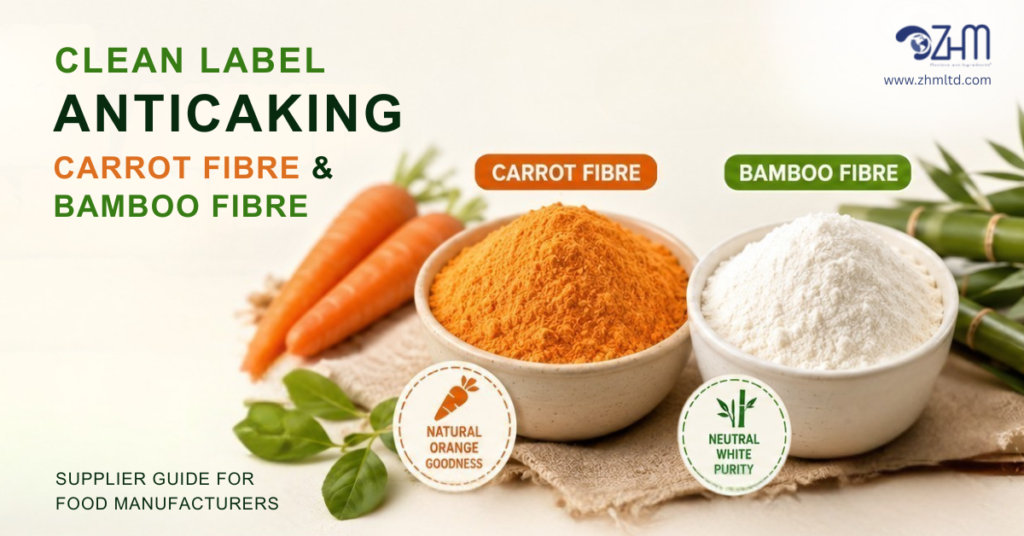
(Image placeholder: Visual comparison of Carrot Fibre powder (orange) and Bamboo Fibre powder (white). Alt text: natural anticaking supplier BD carrot bamboo fibre)
Choosing between Carrot Fibre and Bamboo Fibre for a specific application comes down to understanding the key differences in their properties and how those align with your formulation requirements:
| Parameter | Carrot Fibre | Bamboo Fibre |
| Source | Carrot (Daucus carota) pomace | Bamboo (Bambusoideae) stem cellulose |
| Colour | Natural orange/Yellow-Orange | Bright white / off-white |
| Taste Profile | Mild carrot note (undetectable at <1%). Slight, sweet earthy/carrot note | Completely neutral |
| Label Declaration | "Carrot Fibre" | "Bamboo Fibre" |
| E-Number Required | No | No |
| Dietary Fibre Content | 40–60% (mixed soluble/insoluble) | 95%+ (predominantly insoluble cellulose) |
| Fibre Contribution at 1% | ~0.4–0.6g fibre/100g product | ~0.95g fibre/100g product |
| Nutritional Benefit | Fibre + Beta-carotene (Vit A),
Adds significant dietary fibre |
Fibre only, Primarily insoluble cellulose fibre |
| Primary Mechanism | High water binding capacity | Moisture absorption & physical separation |
| Anticaking Mechanism | Moisture absorption + physical separation | Moisture absorption + particle coating + separation |
| Performance vs E551 | Comparable at 1–2% vs 0.5–1% E551 | Comparable at 1–2% vs 0.5–1% E551 |
| Allergen | None (carrots not a listed allergen) | None |
| Sustainability | Good (by-product utilisation) | Excellent (rapidly renewable) |
| Typical Usage Level | 0.5–2% | 0.5–2% |
| Best Applications | Spice blends, Warm-coloured spice blends, seasoning,dark baking mixes | White powders, protein powders, light baking mixes, creamers, universal use |
| Organic Available | Yes (select suppliers) | Yes (select suppliers) |
| COSMOS Compliant | Yes | Yes |
| Limitations | Unsuitable for pure white products | Less water-binding capacity than carrot |
Decision guide:
The transition to natural, clean-label anticaking agents is happening across nearly every sector of the dry foods industry. Here is how these innovative fibres are being applied:
Bangladesh's food industry produces enormous volumes of mixed spice blends — curry powder, garam masala, biriyani mix, tandoori seasoning, and custom blends for processed food manufacturers. These blends are inherently hygroscopic because many individual spices (salt, chilli powder, onion powder, garlic powder) have high water-absorbing tendencies.
Carrot Fibre is ideal for most Bangladeshi spice blends because the natural orange colouring of Carrot Fibre is complementary to the warm red, orange, and brown colours of typical spice blend products. At 0.5–1%, Carrot Fibre effectively prevents clumping through Bangladesh's rainy season when relative humidity regularly exceeds 80%.
Bamboo Fibre is the preferred choice for white seasoning blends (cream of mushroom seasoning, white pepper blends, vanilla sugar) where the orange colour of Carrot Fibre would be unacceptable.
Instant beverage mixes — flavoured drink powders, instant tea and coffee mixes, electrolyte powders, and nutritional beverages — require excellent flow properties to ensure accurate dosing and consumer convenience. Caking in powdered beverage mixes leads to consumer complaints, product returns, and reputation damage.
Bamboo Fibre is the preferred anticaking agent for most powdered beverage applications because of its white colour and neutral taste. At 0.5–1%, it provides reliable free-flowing performance throughout the product's shelf life, even in Bangladesh's humid climate.
Bakery premixes — bread mix, cake mix, muffin mix, cookie mix — are sold in retail and used by commercial bakeries across Bangladesh. They contain flour, leavening agents (baking powder, baking soda), and flavouring compounds, all of which can absorb moisture and cause the premix to set hard in the bag.
Bamboo Fibre is ideally suited for white and light-coloured bakery mixes, providing anticaking performance without affecting the colour or taste of the finished baked product. Carrot Fibre can be used in wholegrain, multigrain, or high-fibre bakery mixes where its colour and fibre contribution enhance the natural/healthy positioning of the product.
Sports nutrition and dietary supplement manufacturers in Bangladesh are growing rapidly, producing whey protein blends, plant protein powders, vitamin and mineral premixes, and functional supplement powders. These high-protein, high-micronutrient powders are often highly hygroscopic.
Bamboo Fibre is the preferred anticaking agent for protein powders — its white colour does not affect the visual appearance of the powder, its neutral taste does not interfere with flavour systems, and its clean-label declaration complements the natural-ingredient positioning of premium nutrition products.
Table salt and seasoned salt are among the most severely caking-prone food ingredients — sodium chloride (salt) is highly hygroscopic and will form rock-hard clumps within days in Bangladesh's humid climate without an anticaking agent. Both Carrot Fibre and Bamboo Fibre can be used in flavoured salt and seasoning blends, providing natural anticaking without the need for sodium ferrocyanide (E535) or silicon dioxide (E551).
Specialty flour blends — gluten-free flour mixes, high-protein flour blends, and multigrain bakery flour — benefit from clean-label anticaking agents when packed in retail or food service formats. Bamboo Fibre, with its neutral colour and taste, is ideal for premium flour blend products where maintaining a pure white or natural appearance is important.
(For more comprehensive ingredient solutions, explore our main Food Ingredients page.)
The most commercially important regulatory distinction between Carrot Fibre/Bamboo Fibre and synthetic anticaking agents (E551, E535, E572) is their regulatory classification.
Synthetic anticaking agents are classified as food additives — they are specifically added to food to perform a technical function (anticaking), are subject to maximum usage levels regulated by food authorities, and must be declared on food labels with their E-number AND functional class designation (e.g., "Silicon Dioxide (E551), Anticaking Agent").
Carrot Fibre and Bamboo Fibre, by contrast, are classified as food ingredients — natural plant-derived materials that perform a nutritional or functional role in food. They are NOT classified as food additives, carry NO E-number, and are declared on the ingredient list simply by their recognisable name:
This simple, clean ingredient declaration is what makes these ingredients "clean label" in the truest regulatory sense.
Under Bangladesh's food regulations administered by the Bangladesh Standards and Testing Institution (BSTI) and the Bangladesh Food Safety Authority (BFSA), plant-derived dietary fibres used as functional food ingredients are classified as food ingredients — not food additives — and do not require specific additive approval or maximum usage level compliance. They are declared on the ingredient list by their descriptive name.
Food manufacturers using Carrot Fibre or Bamboo Fibre in Bangladesh should:
Products using Carrot Fibre or Bamboo Fibre as anticaking agents can legitimately support:
(Interested in other functional ingredients? Read our guides on Modified Starches and Natural Food Colours.)
Not all natural fibres are created equal. When sourcing carrot or bamboo fibre for industrial food manufacturing, strict quality standards must be maintained to ensure performance and safety.
The anticaking effectiveness of fibre-based agents depends heavily on particle size. Particle size determines how evenly the fibre distributes through the powder matrix and how effectively it coats or separates food powder particles. The efficacy of an anticaking agent depends heavily on its particle size. Finer, micronized powders (often below 50 microns) generally offer better coating and physical separation. We supply specific grades tailored to your powder's density.
| Particle Size Grade | D90 (microns) | Best Applications |
| Fine | <50 μm | Protein powders, fine spice blends |
| Standard | 50–150 μm | Bakery mixes, seasoning, general use |
| Coarse | 150–400 μm | Coarse spice blends, whole grain mixes |
ZHM Group can supply both Carrot Fibre and Bamboo Fibre in multiple particle size grades — contact our team for particle size specifications relevant to your application.
The fibres themselves must be exceptionally dry upon delivery (typically <5% moisture) to maximize their capacity to absorb moisture within your product.
Food-grade anticaking fibres must have low moisture content on arrival to ensure they can perform their moisture-absorbing function effectively. Typical specifications:
As agricultural products, rigorous sterilization and testing are required to ensure strict limits on Total Plate Count, Yeast, Mold, and pathogens like Salmonella and E. coli.
| Parameter | Specification |
| Total Aerobic Microbial Count (TAMC) | ≤ 100,000 CFU/g |
| Total Yeast and Mould Count (TYMC) | ≤ 1,000 CFU/g |
| Salmonella spp. | Absence in 25g |
| E. coli | Absence in 1g |
Comprehensive testing for heavy metals (Lead, Arsenic, Cadmium, Mercury) ensures compliance with stringent food safety regulations. Both Carrot Fibre and Bamboo Fibre are tested against EU Maximum Levels for heavy metals in food:
The dietary fibre content is determined by the AOAC 991.43 or AOAC 2009.01 method — the internationally recognised analytical methods for dietary fibre quantification in food ingredients and finished products.
For brands targeting the premium organic market, certified organic grades of both carrot and bamboo fibre are available upon request.
Both Carrot Fibre and Bamboo Fibre are available in certified organic grades (USDA Organic / EU Organic) for manufacturers producing certified organic food products. Contact ZHM Group to confirm availability of organic-certified anticaking fibre grades.
Follow this five-step decision process when selecting between Carrot Fibre, Bamboo Fibre, or traditional anticaking agents:
Step 1: Assess your product's colour profile If your powder is white or very light-coloured → Bamboo Fibre is your choice. If your powder has a warm orange/red/brown colour profile → Carrot Fibre is compatible.
Step 2: Determine your label positioning If you are pursuing a clean-label or "no additives" positioning → Both Carrot and Bamboo Fibre are suitable. If E-number declaration is acceptable and cost minimisation is the priority → Consider E551 (Silicon Dioxide).
Step 3: Consider the humidity conditions in your market and storage environment Bangladesh's tropical climate (75–90% RH during monsoon) demands higher anticaking agent usage levels than temperate climates. Plan for 1–2% usage level rather than 0.5%.
Step 4: Evaluate particle size compatibility The anticaking agent's particle size should be smaller than or similar to the main powder particles for best distribution and coating effectiveness. Discuss particle size requirements with ZHM Group's technical team.
Step 5: Confirm regulatory and certification requirements If producing for export to EU, UK, or US markets — confirm that Carrot or Bamboo Fibre is recognised as a food ingredient (not additive) in the destination market. Both are widely accepted in major export markets.
ZHM Group is a trusted, specialized Food Ingredients supplier in Bangladesh, dedicated to helping local manufacturers transition to clean-label formulations.
20+ Years of Food Ingredient Sourcing Experience: ZHM Group has supplied food and beverage ingredients to Bangladesh's manufacturing sector for over two decades. We understand the specific challenges of Bangladesh's climate, regulatory environment, and manufacturing requirements better than any other supplier.
Certified Global Sourcing: Both Carrot Fibre and Bamboo Fibre are sourced from internationally certified manufacturers holding ISO 9001, FSSC 22000, and where applicable, Organic certification — ensuring consistent quality batch-to-batch.
Full Technical Documentation: Every delivery of Carrot Fibre and Bamboo Fibre from ZHM Group is accompanied by:
Formulation Support: Our technical team provides application guidance for incorporating Carrot Fibre and Bamboo Fibre into your specific formulation — including usage level recommendations, blending instructions, and troubleshooting guidance for challenging applications.
Flexible MOQ: We supply small quantities for R&D and trial formulation work, scaling to full production batch quantities with competitive bulk pricing. Samples available on request.
Fast Bangladesh Delivery: With our Dhanmondi, Dhaka warehouse, we can deliver food-grade anticaking agents rapidly across Bangladesh — minimising disruption to your production schedule.
A clean label anticaking agent is a natural, plant-derived ingredient that prevents powder clumping and is declared on food labels by its simple, consumer-recognisable name — such as "Carrot Fibre" or "Bamboo Fibre" — rather than an E-number like silicon dioxide (E551). Consumers increasingly associate E-numbers with artificial, over-processed food and respond negatively to them on ingredient lists. Clean label anticaking agents deliver equivalent or comparable anticaking performance to silicon dioxide in most food powder applications while supporting a "natural ingredients," "no additives," or "no E-numbers" product positioning — increasingly important for premium food brands in Bangladesh and in export markets. ZHM Group supplies both Carrot Fibre and Bamboo Fibre as certified clean label anticaking alternatives for Bangladesh's food manufacturers.
At typical anticaking usage levels of 0.5–2%, Carrot Fibre will impart a mild orange or golden tinge to the finished powder product due to its natural beta-carotene content. The intensity of the colour effect depends on the usage level and the colour of the base powder — it is most noticeable in white or very light-coloured powders, and largely imperceptible in warm-coloured or multi-ingredient products like spice blends, curry powder, or wholegrain flour mixes. Regarding taste, Carrot Fibre has a very mild, slightly sweet carrot note that is virtually undetectable at anticaking usage levels (below 1%) in most flavoured or seasoned products. For white-coloured products where any colour change is unacceptable, ZHM Group recommends Bamboo Fibre — which is bright white and completely neutral in taste.
Yes — Bamboo Fibre is the ideal clean label anticaking agent for white-coloured baking mixes, precisely because it is bright white and has a completely neutral flavour profile. At 0.5–2% usage level, Bamboo Fibre prevents clumping in cake mixes, bread mixes, muffin mixes, pancake mixes, and gluten-free flour blends without any visible impact on the powder's appearance or any detectable flavour contribution to the baked product. Bamboo Fibre is composed of 95%+ purified alpha-cellulose — which is white, odourless, and tasteless — making it functionally equivalent to silicon dioxide (E551) in white powder applications while offering the clean-label advantage of a simple "Bamboo Fibre" ingredient declaration.
The typical usage level for both Carrot Fibre and Bamboo Fibre as anticaking agents is 0.5–2% of the total powder weight, depending on the hygroscopicity of the base powder and the ambient humidity conditions during storage and distribution. In Bangladesh's tropical climate — where relative humidity regularly exceeds 75–85% during the monsoon season — we recommend starting at 1% and increasing to 1.5–2% for highly hygroscopic powders such as salt, sugar powders, or hygroscopic spice components. For less hygroscopic powders in controlled storage environments, 0.5–1% may be sufficient. ZHM Group's technical team can advise on the optimum usage level for your specific formulation and storage conditions — contact us for application-specific recommendations.
Yes — both Carrot Fibre and Bamboo Fibre contribute measurably to the total dietary fibre content of the finished product, which may support dietary fibre claims on your food label. Carrot Fibre typically contains 40–60% dietary fibre by weight, while Bamboo Fibre contains 95%+ dietary fibre. At a 1% usage level: Carrot Fibre contributes approximately 0.4–0.6g of dietary fibre per 100g of finished product; Bamboo Fibre contributes approximately 0.95g per 100g. To make a "Source of Fibre" claim (≥3g/100g) or "High in Fibre" claim (≥6g/100g) based on anticaking agent contribution alone, higher usage levels would be required — but the fibre contribution from the anticaking agent can combine with fibre from other ingredients (whole grain flour, vegetables) to reach claim thresholds. Bangladesh food manufacturers should verify specific fibre claim thresholds with BFSA guidelines.
Yes — ZHM Group supplies both Carrot Fibre and Bamboo Fibre in bulk quantities for food manufacturers across Bangladesh. We offer flexible order sizes: small quantities (from 5–25kg) for initial R&D formulation trials and product development testing, through to full production quantities (200kg+, 1MT+) for commercial manufacturing with competitive bulk pricing. Both products are available from our Dhaka warehouse for fast nationwide delivery. Samples are available on request for initial evaluation. Contact ZHM Group at +88029634158 or [email protected] to discuss your specific requirements, volume, and to receive a tailored bulk quotation.
Are you a food & beverage manufacturer in Bangladesh looking to source certified Anticaking Agents (Carrot Fibre & Bamboo Fibre) in bulk quantities?
ZHM Group supplies food-grade ingredients with full documentation — CoA, SDS, TDS, INCI documentation, technical data sheets. — to food manufacturers across Bangladesh. We offer flexible MOQ for R&D batches and competitive pricing for bulk production orders. Fast delivery from our Dhaka warehouse. Our team provides technical formulation support for anticaking agent selection and usage level guidance.
Request Bulk Quote & Samples
Download Technical Data Sheet