ভিটামিন A সমৃদ্ধ স্মার্ট সুগার! — এখন বাজারে
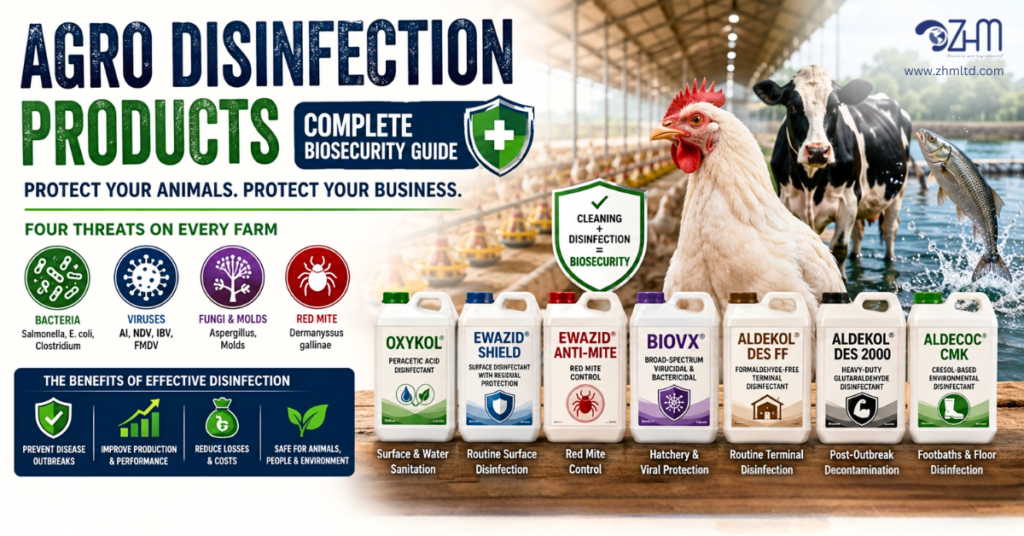
Disease prevention in Bangladesh's poultry, livestock, and aquaculture industries depends heavily on effective biosecurity protocols. At the heart of these protocols is the rigorous disinfection of premises, equipment, and water systems after thorough cleaning. Choosing the right agro disinfection products in Bangladesh for each situation — whether it's routine disinfection, terminal disinfection between flocks, targeted mite control, or water treatment — is critical for biosecurity compliance and stopping disease outbreaks before they start. ZHM Group supplies seven specialised agro disinfection products covering all farm biosecurity needs, ensuring a safe and productive environment for your agricultural business.
If you manage a poultry farm, fish hatchery, dairy facility, or livestock operation in Bangladesh, you already know one thing for certain: disease outbreaks cost money — a lot of it. A single outbreak of Newcastle Disease in a broiler house can wipe out an entire flock in days. A contaminated hatchery can fail multiple batches before the source is identified. Red mite infestation can push a laying flock into significant production decline for months.
The good news? Most of these disasters are preventable. And the key is having the right agro disinfection products — and knowing how and when to use them.
Agro disinfection products Bangladesh farmers use vary widely in their active ingredients, their target organisms, and their intended applications. Some are designed for routine surface disinfection after cleaning. Some are for emergency terminal disinfection after a disease outbreak. Some specifically target red mite. And some are formulated for water system and footbath use.
ZHM Group supplies seven specialised agro disinfection products that cover every biosecurity need on Bangladesh's farms — from routine maintenance to outbreak response. This guide explains each product in plain language: what it contains, how it works, where to use it, and how to build a complete, rotation-based disinfection programme that actually protects your operation.
Let us start with the fundamentals.
In the context of modern farming, basic cleaning isn't enough. Farms are complex environments where bacteria, viruses, fungi, and parasites can thrive if not actively managed. Effective agro disinfection requires targeted chemical interventions designed to eliminate these microscopic threats from surfaces, equipment, and even the air.
A comprehensive biosecurity program relies on different types of disinfectants to target specific pathogens. For instance, broad-spectrum virucidal agents are needed to combat tough viral outbreaks, while specialised acaricides are necessary for dealing with parasitic infestations like red mites. The goal is to break the chain of infection, reducing mortality rates, improving feed conversion ratios, and ultimately protecting the profitability of agricultural operations in Bangladesh.
Before choosing a disinfectant, it helps to understand what you are trying to kill. Farm environments harbour four major categories of disease-causing organisms, and not all disinfectants work equally well against all four.
A critical point that many farm managers miss: disinfectants cannot work properly on dirty surfaces. Organic matter (manure, blood, feed residue, biofilm) physically blocks disinfectant from reaching pathogens, and chemically neutralises many active compounds — reducing efficacy by up to 90%.
Always follow the clean-first rule:
Now let us look at each of ZHM Group's seven agro disinfection products in detail.
OXYKOL® is a highly effective, fast-acting disinfectant based on peracetic acid (PAA). It is a powerful oxidising agent known for its broad-spectrum efficacy against bacteria, viruses, fungi, and spores.
OXYKOL® is a peracetic acid (PAA)-based disinfectant — one of the most effective and environmentally responsible disinfection chemistries available for agricultural use. If you are looking for a disinfectant that is powerful, broad-spectrum, and breaks down into completely safe residues, OXYKOL® is hard to beat.
OXYKOL® works by disrupting the cell membranes of microorganisms through rapid oxidation, leading to cell death. One of the most significant advantages of peracetic acid is its excellent environmental profile. After use, OXYKOL® breaks down naturally into safe, harmless by-products: water, oxygen, and acetic acid (vinegar). This means it leaves no toxic residues, making it an exceptionally safe choice for both the animals and the environment.
This versatile product is used extensively for surface disinfection in animal housing, hatcheries, and food processing areas. It is also commonly used for water line sanitation, helping to remove biofilm build-up.
Active ingredient: Peracetic acid (PAA) Chemical group: Peroxy acid Physical form: Clear liquid with a pungent vinegar-like odour Available packaging: Contact ZHM Group for current pack sizes and concentrations
Peracetic acid works by releasing highly reactive oxygen radicals (free radicals) that attack and destroy the cell membranes of bacteria, the protein coats of viruses, and the cell walls of fungi. This oxidative mechanism is extremely effective and, critically, organisms cannot develop resistance to it — unlike with some antibiotic-type biocides.
Spectrum of activity:
No toxic residues: Peracetic acid breaks down into acetic acid (vinegar) and oxygen — both completely harmless to animals, humans, and the environment. This makes OXYKOL® ideal for use in areas where residue concerns are paramount — water systems, food processing areas, and situations with short withdrawal periods before restocking.
Effective in cold water: Many disinfectants require warm water to perform effectively. OXYKOL® works in cold water — an important practical advantage during Bangladesh's cooler winter months.
Water treatment compatible: OXYKOL® can be used for water system disinfection — drinking water lines, storage tanks, and water pipes — at appropriate dilutions. Consult ZHM Group's technical team for water treatment-specific protocols.
Short contact time: Peracetic acid achieves effective disinfection in shorter contact times than many alternative chemistries.
Practical Applications of OXYKOL®:
When you need long-lasting protection, EWAZID® SHIELD is a premium choice. It is formulated to provide powerful initial disinfection followed by ongoing residual action.
Not all disinfection situations require the same approach. For routine maintenance disinfection — where you want ongoing protection between more intensive disinfection events — EWAZID® SHIELD is specifically designed to deliver residual protection that continues working on surfaces long after application.
EWAZID® SHIELD utilizes a synergistic blend of active ingredients designed to not only kill pathogens on contact but also to form a protective, microscopic film on treated surfaces. This residual protection mechanism ensures that surfaces remain hostile to bacteria and viruses long after the initial application has dried.
Biocidal compound with residual substantivity (contact ZHM Group for current formulation details and SDS)
Physical form: Liquid concentrate for dilution
Key differentiator: Residual surface protection — not just one-time kill
It is applied via spraying or foaming onto pre-cleaned surfaces. The exact application rate will depend on the level of contamination and the specific area being treated. It is crucial to adhere to the recommended withdrawal periods and usage guidelines provided in the technical data sheet to ensure safety and maximum efficacy in poultry and livestock environments.
EWAZID® SHIELD works in two phases:
Phase 1 — Immediate kill: On application, the active biocidal compound rapidly kills bacteria, viruses, and fungi present on the treated surface — delivering an immediate high-log reduction in microbial contamination.
Phase 2 — Residual protection: Unlike standard disinfectants that provide only a one-time kill and offer no protection after drying, EWAZID® SHIELD leaves a residual antimicrobial film on treated surfaces. This film continues to exert antimicrobial activity against new microbial contamination that lands on the surface after application — providing ongoing protection during the period between thorough disinfection events.
This residual mechanism is particularly valuable in:
Practical Applications of EWAZID® SHIELD:
Poultry red mites (Dermanyssus gallinae) are a severe problem in Bangladesh poultry farms. These blood-sucking parasites cause stress, anemia, reduced egg production, and can transmit diseases, leading to significant economic losses. EWAZID® ANTI-MITE is specifically designed to combat this persistent threat.
EWAZID® ANTI-MITE offers a targeted approach to mite control. Its specific mode of action targets the nervous system of the mites, providing rapid knockdown and long-lasting control of both adult mites and their developmental stages.
For effective red mite control, EWAZID® ANTI-MITE must be applied correctly.
Red mite (Dermanyssus gallinae) is one of the most serious and underestimated threats facing Bangladesh's laying hen and broiler breeder operations. These tiny blood-sucking parasites — barely 1mm in length when unfed — hide during daylight hours in cracks, crevices, perches, nest boxes, and wall joints. At night, they emerge to feed on roosting birds.
Here is why red mite is so damaging:
Bangladesh's humid tropical climate — combined with dense rural poultry production — creates near-ideal conditions for red mite population explosions. Any laying house manager in Bangladesh who has not yet encountered red mite is either very lucky or not looking carefully enough.
EWAZID® ANTI-MITE is specifically formulated for red mite control — with an active ingredient system and formulation designed to penetrate into the hiding places where red mite lives and breeds.
Primary mode of action: Contact acaricide — kills mites on contact with the treated surface, disrupting their nervous system or metabolic processes Residual activity: Extended residual effect in treated cracks and crevices, providing ongoing control of mites emerging from hiding
Why EWAZID® ANTI-MITE is different from standard disinfectants: Standard disinfectants target bacteria, viruses, and fungi — they are generally not effective against red mite. EWAZID® ANTI-MITE is specifically formulated for ectoparasite control, with its active compound and formulation optimised for mite contact and penetration into hiding sites.
When to apply:
Where to apply:
Application method:
Important: Always follow the product SDS and allow appropriate withdrawal periods before restocking. Contact ZHM Group for current dilution rates and safety guidance.
BIOVX® is a highly concentrated, broad-spectrum disinfectant renowned for its powerful virucidal and bactericidal properties. It is a cornerstone product for maintaining high-level biosecurity.
When you need a disinfectant with proven broad-spectrum activity that specifically includes virucidal performance — for hatcheries, disease outbreak response, or high-risk biosecurity situations — BIOVX® is the product to reach for.
Active ingredients: Broad-spectrum biocidal compounds with documented virucidal activity (contact ZHM Group for current formulation documentation and EN test data)
Physical form: Liquid concentrate
Special strength: Proven virucidal activity — important for Avian Influenza and Newcastle Disease response
BIOVX® is formulated to deliver activity across the complete spectrum of farm pathogens, features a complex formulation of active ingredients that deliver a devastating blow to a wide range of pathogens. It is proven highly effective against:
Hatcheries: The hatchery environment is the single most biosecurity-critical area in any poultry operation. A contaminated hatchery can infect every chick passing through — spreading disease to farms across a large geographical area. BIOVX®'s proven virucidal activity makes it ideal for hatchery terminal disinfection between hatches.
Post-outbreak terminal disinfection: When a flock has been affected by a viral disease (Avian Influenza, Newcastle Disease), terminal disinfection after depopulation must be verified to achieve a full virucidal effect. BIOVX® provides this assurance with documented virucidal efficacy.
High-risk biosecurity areas: Entrance gate disinfection, vehicle disinfection, ante-room disinfection — anywhere that represents a critical biosecurity boundary where virucidal performance is specifically important.
Practical Applications of BIOVX®:
Because of its reliable efficacy, BIOVX® is widely used in critical areas such as hatcheries, where preventing vertical disease transmission is paramount. It is also excellent for routine farm disinfection, boot dips, and equipment sanitation.
Terminal disinfection—the deep cleaning and disinfection process between flocks or herds—is critical. ALDEKOL® DES FF provides powerful terminal disinfection without the use of formaldehyde.
For many years, formaldehyde was the default choice for terminal disinfection in poultry facilities — effective, but associated with serious worker health risks (carcinogen, respiratory irritant) and strict regulatory restrictions in many markets. ALDEKOL® DES FF delivers high-level terminal disinfection performance without formaldehyde — making it the modern, safer choice for Bangladesh farm operators.
Active ingredient: Glutaraldehyde-free aldehyde complex (advanced aldehyde chemistry without formaldehyde or glutaraldehyde)
This product utilizes a glutaraldehyde-free and formaldehyde-free aldehyde complex. It is designed to offer the heavy-duty killing power traditionally associated with aldehydes but with a significantly improved safety profile.
Key advantage: No formaldehyde — safer for applicators; no formaldehyde residue concerns Classification: High-level terminal disinfectant
ALDEKOL® DES FF contains a blend of advanced aldehyde-based compounds that alkylate (chemically modify) the proteins and nucleic acids of pathogens — permanently inactivating their ability to replicate and cause infection. Aldehyde chemistry is among the most effective classes of biocidal action available for terminal disinfection — achieving high-log reductions against bacteria, viruses, fungi, and spores.
The "FF" designation (formaldehyde-free) is critical: it achieves aldehyde-class efficacy without the occupational health risks and regulatory restrictions associated with formaldehyde.
Spectrum of activity:
Terminal disinfection protocol with ALDEKOL® DES FF:
When to use ALDEKOL® DES FF:
The primary advantage is lower toxicity and reduced respiratory irritation for farm workers during application, while still maintaining effective broad-spectrum efficacy against tough pathogens.
For situations demanding the most robust terminal disinfection, particularly against highly resistant viruses and bacterial spores, ALDEKOL® DES 2000 is the solution.
For the most challenging terminal disinfection situations — heavily contaminated facilities, post-disease outbreak decontamination, or facilities with a history of persistent contamination problems — ALDEKOL® DES 2000 provides maximum-strength aldehyde disinfection power.
The active ingredient here is glutaraldehyde, a powerful chemical sterilant. ALDEKOL® DES 2000 is formulated for heavy-duty terminal disinfection in environments that have experienced severe disease challenges or where the highest possible level of biosecurity is required.
Active ingredient: Glutaraldehyde (high-concentration) Classification: Maximum-strength terminal disinfectant Best for: High-contamination situations, post-outbreak decontamination
Both ALDEKOL® DES FF and DES 2000 are terminal disinfectants with aldehyde-based activity. The key differences:
| Parameter | ALDEKOL® DES FF | ALDEKOL® DES 2000 |
| Active | Formaldehyde-free aldehyde complex | Glutaraldehyde |
| Formaldehyde | No | No |
| Strength | High-level | Maximum-strength |
| Toxicity | Lower (no formaldehyde) | Higher (glutaraldehyde requires careful handling) |
| Best for | Routine terminal disinfection | Post-outbreak, highly contaminated areas |
| Worker safety | Better tolerated | Requires full PPE, ventilation protocol |
| Cost | Standard | Higher |
Choose ALDEKOL® DES 2000 when:
Safety reminder: Glutaraldehyde is a strong sensitiser and irritant. Always use full personal protective equipment (PPE) when handling and applying ALDEKOL® DES 2000 — refer to the SDS provided by ZHM Group for full safety requirements.
Due to its potency, specific protocols must be followed. It is ideal for use in highly contaminated areas, concrete floors, and rough surfaces where deep penetration is necessary. Proper ventilation and personal protective equipment (PPE) are essential during application.
ALDECOC® CMK is a heavy-duty, cresol/phenol-based disinfectant designed specifically for challenging environmental conditions where high levels of organic matter are present.
ALDECOC® CMK is a cresol and phenol-based disinfectant — one of the most established chemical classes in farm disinfection, widely used for floor washing, footbath filling, perimeter treatment, and general environmental disinfection on livestock farms.
Formulated with cresol and phenol derivatives, ALDECOC® CMK excels in cutting through dirt and grime to deliver reliable disinfection.
Active ingredients: Cresol / phenol-based compounds Physical form: Dark brown liquid with characteristic phenolic odour
Applications: Floor disinfection, footbaths, perimeter, environmental
Phenol and cresol compounds work by denaturing (unfolding) the proteins that bacteria and other microorganisms need to survive and function. They disrupt cell membranes, inhibit enzyme activity, and cause irreversible damage to microbial cell structures.
Spectrum of activity:
Where ALDECOC® CMK Works Best:
Footbaths: Footbaths at farm entry points are one of the most important physical biosecurity barriers on any Bangladesh farm. ALDECOC® CMK is well-suited for footbath use — it maintains adequate activity over extended periods in the footbath, it performs adequately in the presence of some organic matter (important in footbaths), and it produces the characteristic dark colour that confirms the footbath is active.
Floor washing disinfection: For farm building floors, walkways, and outdoor hard surfaces around farm buildings, ALDECOC® CMK provides effective bacterial decontamination at economical cost.
Perimeter treatment: Spraying around farm perimeters, entrance roads, and vehicle access points helps reduce the bacterial load on surfaces that are difficult to control through other means.
Practical Applications of ALDECOC® CMK:
Not recommended for: Virucidal applications (limited virus activity), surfaces in direct contact with animals without appropriate rinsing.
Use this reference table to quickly identify the right product for each situation:
| Situation | Recommended Product | Primary Active | Primary Target Organisms | Typical Usage | Usage Area | Main Application |
| Water line & drinker disinfection | OXYKOL® | Peracetic Acid | Bacteria, viruses, fungi, biofilm | 0.01–0.1% | Animal housing, water lines | Surface & Water Sanitation |
| Routine surface disinfection during cycle | EWAZID® SHIELD | Residual biocide, Synergistic Blend | Bacteria, viruses, fungi(Residual) | 0.25–1% | General farm surfaces | Surface Disinfection |
| Red mite control | EWAZID® ANTI-MITE | Contact acaricide, Acaricide Blend | Red mite (Dermanyssus) | Per label | Poultry housing, cracks/crevices | Parasite Control |
| Hatchery disinfection & viral threats | BIOVX® | Broad-spectrum virucide | Bacteria, viruses (including AI, NDV) | Per TDS | Hatcheries, boot dips, equipment | Routine & Hatchery |
| Routine terminal disinfection | ALDEKOL® DES FF | Aldehyde complex (FF) | Bacteria, viruses, fungi, spores | Per TDS | Empty animal housing | Terminal Disinfection |
| Post-outbreak terminal disinfection | ALDEKOL® DES 2000 | Glutaraldehyde, Aldehyde Complex (Formaldehyde-Free) | Maximum spectrum including resistant organisms | Per TDS | Highly contaminated areas | Heavy-Duty Terminal |
| Footbaths & floor disinfection | ALDECOC® CMK | Cresol/phenol | Bacteria, fungi | 1–5% | Floors, footbaths, perimeters | Heavy Organic Load |
Just like antibiotics, overuse of a single type of disinfectant can lead to pathogens developing resistance. To ensure long-term biosecurity effectiveness, farms must implement a Disinfection Rotation Protocol.
This involves periodically switching between disinfectants with different modes of action (different active chemical families). For example, rotating a peracetic acid product (like OXYKOL®) with an aldehyde-based product (like ALDEKOL® DES FF) prevents surviving bacteria from adapting to one specific chemical stressor. ZHM Group's technical team can assist you in designing a customized rotation program utilizing our diverse range of products.
One of the most common mistakes farm managers make is using the same disinfectant, at the same concentration, in the same way, cycle after cycle. This approach seems efficient — but it can actively make your biosecurity programme less effective over time.
Pathogen adaptation: Repeated exposure to the same biocidal mechanism can select for tolerant organisms — populations that are less susceptible to that particular class of active compound. This is not true antibiotic-style resistance in most cases, but tolerance creep is real.
Incomplete coverage: No single disinfectant is equally effective against every pathogen at every stage of their lifecycle. Rotating between different chemical classes ensures that any organism with reduced susceptibility to one class is challenged by a completely different mechanism in the next cycle.
Regulatory compliance: In markets with export biosecurity requirements (EU, UK, GCC), documented rotation protocols are increasingly required as evidence of a robust biosecurity management system.
Every depopulation (between every flock or cycle):
Routine during production cycle (monthly):
Water system (monthly or when turbidity increases):
Red mite programme (quarterly + at depopulation):
Post-outbreak emergency protocol:
EWAZID® SHIELD and EWAZID® ANTI-MITE are both from the EWAZID product range but are designed for completely different purposes. EWAZID® SHIELD is a broad-spectrum surface disinfectant that targets bacteria, viruses, and fungi on farm surfaces — with a residual protection mechanism that continues working after drying. It is used for routine surface disinfection of buildings, equipment, and biosecurity areas. EWAZID® ANTI-MITE, by contrast, is specifically formulated to control red mite (Dermanyssus gallinae) — a blood-sucking ectoparasite that infests poultry houses. Standard disinfectants like EWAZID® SHIELD are not effective against red mite. EWAZID® ANTI-MITE contains a contact acaricide specifically active against mites, formulated to penetrate into the cracks and crevices where mites hide during daylight hours. In short: use EWAZID® SHIELD for microbial biosecurity; use EWAZID® ANTI-MITE specifically when red mite is a concern.
OXYKOL® works through oxidative killing — one of the most powerful and resistance-proof disinfection mechanisms available. Peracetic acid (PAA), the active compound in OXYKOL®, generates highly reactive oxygen species (ROS) that attack and destroy the cell membranes of bacteria, the protein structures of viruses, and the spore coats of fungi. This oxidative damage is irreversible and kills pathogens very rapidly. What makes peracetic acid particularly valuable for farm use is its environmental profile: it breaks down into acetic acid (the same acid found in vinegar) and oxygen — both completely harmless. This means OXYKOL® leaves no toxic residues on farm surfaces or in water systems, making it safe to use in areas where animals will return shortly after treatment and ideal for water line disinfection. OXYKOL® is also effective in cold water — unlike some disinfectants that require warm water to perform correctly — which is an important practical advantage during Bangladesh's cooler winter months.
Red mite (Dermanyssus gallinae) is a tiny blood-sucking external parasite that affects poultry — particularly laying hens — in Bangladesh. The mites are about 0.7–1mm long and are almost invisible to the naked eye until they have fed on blood, when they turn red. During the day, mites hide in cracks, crevices, perch joints, nest boxes, and wall gaps. At night, they emerge to feed on roosting birds for 1–2 hours before retreating. Even moderate infestations cause significant problems: anaemia and reduced egg production, increased stress and feather pecking among hens, potential disease transmission (mites can carry Salmonella and other pathogens), and in severe cases, direct mortality particularly in young or immunocompromised birds. EWAZID® ANTI-MITE controls red mite through a contact acaricide mechanism — killing mites on direct contact with treated surfaces. The product's formulation is specifically designed to penetrate into the crevices and harborage sites where mites hide, achieving effective population reduction both at the time of application and through residual activity. For best results, apply EWAZID® ANTI-MITE at every depopulation as part of the cleanout protocol, paying particular attention to all cracks, joints, perch ends, and electrical housing.
Both ALDEKOL® DES FF and ALDEKOL® DES 2000 are high-level terminal disinfectants from the ALDEKOL range — designed for use after thorough cleaning of farm buildings between production cycles. The key difference is the type and strength of their aldehyde-based active compounds. ALDEKOL® DES FF (FF stands for "formaldehyde-free") uses an advanced aldehyde complex that does not contain formaldehyde or glutaraldehyde — making it safer for applicators, with lower toxicity and no formaldehyde residue concerns. It is the preferred choice for routine terminal disinfection at the end of a standard production cycle. ALDEKOL® DES 2000 contains glutaraldehyde — a more potent but higher-toxicity aldehyde that provides maximum-strength terminal disinfection. It is specifically chosen for post-outbreak decontamination (after confirmed disease events like Avian Influenza or Newcastle Disease), for facilities with persistent contamination problems, or when maximum-assurance disinfection is required before introducing high-value breeding stock. Always use full PPE when handling ALDEKOL® DES 2000 — refer to the Safety Data Sheet from ZHM Group for complete handling requirements.
Setting up a disinfection rotation programme involves selecting different chemical classes for successive disinfection cycles, ensuring that no single chemical mechanism is applied repeatedly without interruption. Here is a practical framework for Bangladesh broiler farms: At every depopulation, clean thoroughly first (EWA® FIX foam + high-pressure wash), then apply terminal disinfectant — alternate between ALDEKOL® DES FF and BIOVX® on successive cycles. During the production cycle, maintain footbaths with ALDECOC® CMK (refresh every 24–48 hours) and apply EWAZID® SHIELD monthly for routine surface maintenance. Treat water lines with OXYKOL® monthly or when contamination is suspected. Apply EWAZID® ANTI-MITE at every depopulation as a standard step regardless of whether mites have been observed — prevention is far cheaper than treating an established infestation. Document every application: product name, dilution rate, application area, date, and applicator name. This documentation is increasingly required by buyers, insurance providers, and export certification auditors. ZHM Group's technical team can help you design a programme specific to your farm type, flock size, and regional disease pressure.
Yes — ZHM Group supplies all seven agro disinfection products, including BIOVX® and OXYKOL®, with complete technical documentation to Bangladesh farm operators and agri-business companies. For each product, we provide: Safety Data Sheet (SDS) covering health hazards, PPE requirements, first aid, storage, and disposal; Technical Data Sheet (TDS) with dilution rates, contact times, application methods, and spectrum of activity data; Certificate of Analysis (CoA) confirming active ingredient content and product specification compliance; and application guidance notes specific to poultry, livestock, and aquaculture applications in Bangladesh. We also provide technical consultation — our team can advise on dilution rates for specific applications, help design rotation protocols, and provide guidance on biosecurity programme development. Contact ZHM Group at +88029634158 or email [email protected] to request product documentation, samples for evaluation, or a bulk pricing quotation.
Are you a poultry farm, livestock facility, fish hatchery, or aquaculture operation in Bangladesh looking to source professional-grade agro disinfection products — OXYKOL®, EWAZID® SHIELD, EWAZID® ANTI-MITE, BIOVX®, ALDEKOL® DES FF, ALDEKOL® DES 2000, and ALDECOC® CMK — in bulk quantities?
ZHM Group is Bangladesh's trusted industrial ingredient supplier with 20+ years of experience. We supply certified agro disinfection products with full technical documentation — TDS, SDS, CoA — and offer competitive pricing for both trial and bulk production orders. Fast delivery from our Dhaka warehouse. Our technical team provides application support and biosecurity programme guidance.
View All Industrial Ingredients
Request Technical Data Sheet
Contact ZHM Group Today +88029634158 | +8801726968877, [email protected]